
Introduction
For over two decades, appearing on the first page of Google was the defining goal of digital visibility. Businesses invested heavily in Search Engine Optimization - refining keywords, building backlinks, improving page speed - all in pursuit of higher rankings and more organic traffic.
That foundation still matters. But something fundamental is shifting in how people find information online.
AI-powered search experiences are no longer experimental. Tools like Google's AI Overviews and AI assistants like ChatGPT, Preplexity, Gemini are changing user behavior at scale. Instead of scanning a list of links, users ask a direct question and receive a synthesized answer often without clicking through to any website at all.
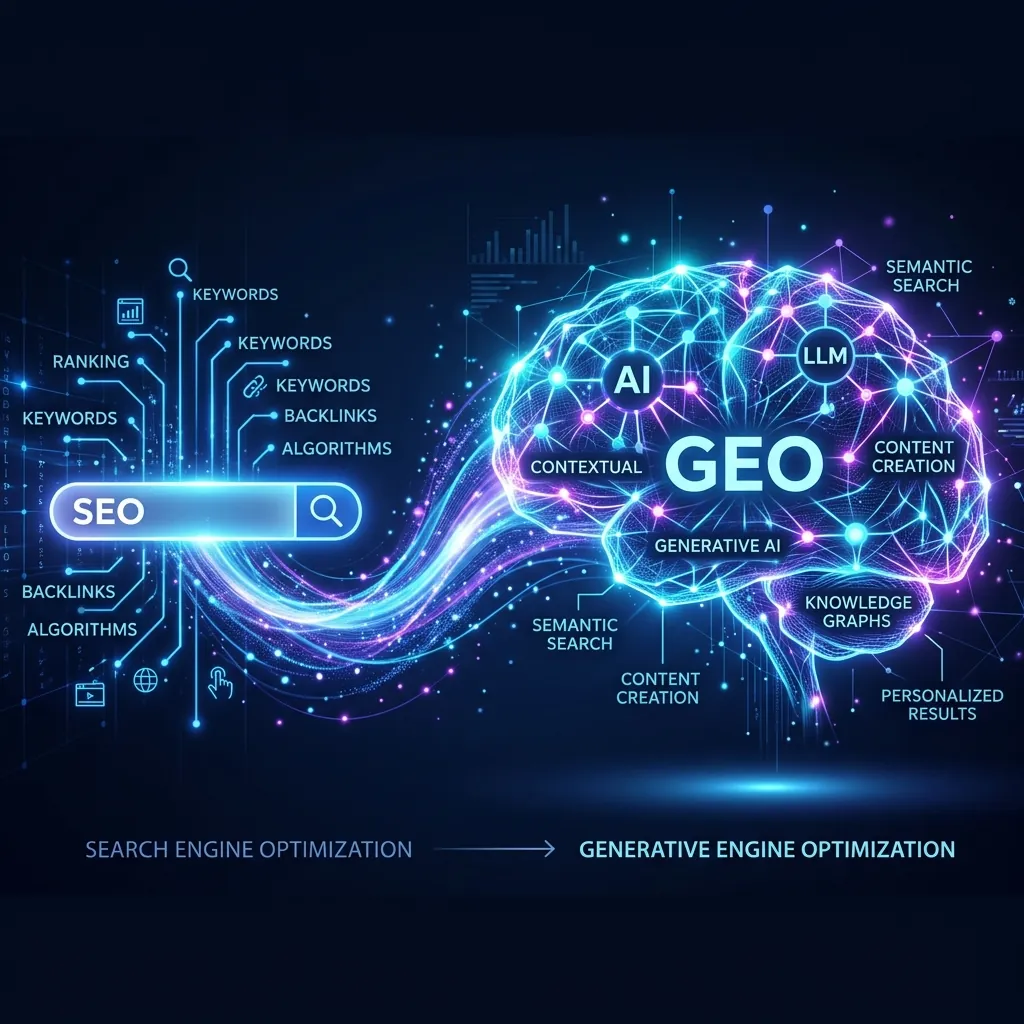
This creates a new visibility problem. You can rank on page one of Google and still be completely absent from the AI-generated answers your potential customers are reading. Solving that problem requires understanding a new discipline alongside SEO: Generative Engine Optimization (GEO).
How Search Engines Work - and Why It Matters
To optimize effectively, it helps to understand what search engines actually evaluate. When Google crawls your site, its algorithms assess signals across three broad categories:
- Technical signals - Can search engines access, crawl, and index your pages efficiently? Slow page speed, broken links, or poor mobile experience directly reduce your ability to rank regardless of content quality.
- Content signals - Does your content clearly address what users are searching for? Search engines evaluate topical depth, heading structure, readability, and how well a page answers the intent behind a query not just the keywords it contains.
- Authority signals - Is your website a credible source in your industry? This is determined by the quality of external websites linking to yours, your brand's online reputation, and consistent publishing of valuable content over time.
What is SEO?
Search Engine Optimization is the ongoing process of making your website easier for search engines to find, understand, and rank for queries relevant to your business.
On-Page SEO
On-page SEO covers everything within your control on individual pages, the content, structure, and how search engines read it.
Implementation Example - Service Page Structure:
Page Title:  Custom Software Development Services | Your Company
Meta Desc:   We build scalable web and mobile applications for
             startups and enterprises. Explore our process.

H1:  Custom Software Development Services
H2:  What We Build
H2:  Our Development Process
  H3:  Discovery and Planning
  H3:  Development and Testing
  H3:  Deployment and Support
H2:  Industries We Serve
H2:  Frequently Asked Questions
Implementation Example - URL Structure:
Clean, descriptive URLs tell search engines and users exactly what the page is about before they even visit it.
Off-Page SEO
Off-page SEO is primarily about building authority through backlinks - links from reputable, relevant websites that signal credibility to search engines.
Implementation Example - Earning Quality Backlinks:
Instead of paying for low-quality directory links, focus on strategies that earn links naturally:
- Publish original research or industry reports that other websites reference
- Write guest articles for respected publications in your industry
- Get listed in genuine business directories like Clutch, GoodFirms, or G2
- Create free tools or resources that other sites link to as a reference
A single backlink from a well-known technology publication carries more SEO value than fifty links from generic directories.
Technical SEO
Technical SEO ensures your site's infrastructure supports crawling and indexing efficiently.
Implementation Example - Core Web Vitals:
Largest Contentful Paint (LCP)  → Target: under 2.5 seconds
Interaction to Next Paint (INP) → Target: under 200ms
Cumulative Layout Shift (CLS)   → Target: score under 0.1
What is GEO?
Generative Engine Optimization is the practice of structuring your content so that AI-powered search systems can accurately understand, extract, and reference it when generating answers for users.
This is a meaningfully different challenge from traditional SEO. Search engines rank pages and show links. AI systems read content across many sources, synthesize the information, and produce a single direct answer. Your website may never appear as a clickable result - but your content may be the source the AI draws from.
What Makes Content GEO-Ready
GEO prioritizes clarity and context over keyword density.
Implementation Example - Rewriting for GEO:
"Custom software development is a great solution for businesses looking for tailored software solutions that meet their unique needs and requirements."
"Custom software development is the process of designing and building applications specifically for a single organization's workflows, rather than purchasing off-the-shelf software. Unlike generic tools, custom software integrates with your existing systems, eliminates unnecessary features, and scales precisely as your business evolves."
SEO vs GEO: Key Differences
| Dimension | SEO | GEO |
|---|---|---|
| Visibility type | Ranked link in search results | Referenced in AI-generated answers |
| Content priority | Keyword relevance, user intent | Clarity, accuracy, contextual depth |
| Authority signals | Backlinks, domain credibility | Factual consistency, citation potential |
| Success metric | Rankings and organic traffic | AI citations and brand mentions |
| User journey | User clicks through to your site | User receives a direct answer |
Why GEO Is Becoming Essential
Search behavior is shifting from short keyword queries toward detailed, intent-driven questions. AI systems are specifically designed to answer this second type of query and they are becoming the preferred tool for users doing research or comparing options before making a purchase decision.
A business that only optimizes for traditional search is optimizing for a shrinking share of how research actually happens.
How to Build a Strategy That Covers Both
Create Content Around User Intent
Instead of a generic "Our Services" page, publish content that answers real questions your customers ask before making a decision.
Structure Content for Both Audiences
Use a clear heading hierarchy (H1 → H2 → H3) where each section is self-contained enough to make sense if extracted independently.
H2: Our Approach
H2: What We Do
H2: How We Plan a Custom Software Project
H2: Technologies We Use and Why
Build Topical Authority
Publishing one strong article is useful. Publishing a cluster of well-connected articles that cover a topic comprehensively signals authority to both search engines and AI systems.
Keep Content Accurate and Current
AI systems prioritize content that is accurate and up to date. Outdated statistics or vague claims reduce your credibility with both search engines and AI tools.
Common Mistakes That Hurt Both SEO and GEO
- Thin content - Pages that touch a topic without meaningfully addressing it rank poorly and will never be cited by AI systems
- Keyword stuffing - Reduces the natural clarity that AI systems depend on, and modern search algorithms already penalize it
- Poor technical performance - Slow pages and broken structure make your content inaccessible to both crawlers and AI indexing systems
- No content updates - Outdated content loses ranking authority and is deprioritized by AI systems that favor current, accurate information
- Writing for algorithms instead of people - Content optimized purely for bots performs poorly with modern search engines and is essentially invisible to GEO
How to Measure Your SEO & GEO Success
Implementing a strategy is only the first step. You need to actively monitor how both search engines and AI systems are interacting with your content. Here is a practical approach to validating your setup.
Testing Your Technical Foundation
Before expecting any ranking improvements, ensure your site is technically sound and accessible to crawlers:
- Verify rendering: Use tools like
curlor Google Search Console's "Test Live URL" to ensure your specific page titles and content are being served correctly, not just a generic homepage fallback. - Submit sitemaps: Ensure your
sitemap.xmlis submitted to both Google Search Console and Bing Webmaster Tools. - Validate structured data: Run your key pages through the Rich Results Test to confirm schemas (like Organization or FAQ) are error-free.
Tracking SEO Performance
Traditional SEO success can be tracked through familiar metrics:
- Indexing status: Monitor the "Discovered" URL count in Search Console and use the
site:yoursite.comsearch operator to confirm pages are indexed. - Search appearance: Verify that the actual search result snippets match your optimized meta titles and descriptions.
- Keyword movement: Track your rankings for high-intent industry terms over time.
Measuring GEO Visibility
Tracking AI visibility requires a different approach since AI tools don't provide a traditional "Search Console":
- Direct querying: Ask platforms like Google AI Overviews and AI assistants like ChatGPT, Preplexity, Gemini (with browsing enabled) questions relevant to your business (e.g., "best web development company in [Your City]") to see if you are cited as a source.
- Monitor bot activity: Check your server's raw access logs for user-agents like
GPTBot,PerplexityBot, orClaudeBotto confirm AI crawlers are actively reading your site.
When to Expect Results: A Realistic Timeline
Patience is critical in digital marketing. While technical fixes can be verified instantly, building authority takes time.
| Milestone | Expected Timeframe |
|---|---|
| Technical checks pass and structured data validates | Immediate |
| Google/Bing discover and index new pages | 1–2 weeks |
| First citations in real-time AI tools (like Perplexity) | 1–2 weeks |
| Mentions in AI tools like ChatGPT and Google AI Overviews | 2–8 weeks |
| Noticeable movement in traditional keyword rankings | 1–2 months |
| Consistent, repeatable citations across all platforms | 2–3 months |
| Full compounding authority and organic traffic growth | 3–6 months |
site: search, asking one AI platform a relevant question, and reviewing your Search Console coverage report is enough to track real movement without getting distracted by daily fluctuations.
Conclusion
SEO remains the essential foundation of online visibility helping your website rank in search results and attract organic traffic every day.
GEO addresses the growing share of search happening through AI tools where visibility means being cited in a generated answer, and where clarity and credibility determine whether you exist in that conversation at all.
Together, they are not two separate strategies. They are two expressions of the same core principle: create content that is genuinely useful, clearly structured, and easy to trust and both search engines and AI systems will reward you for it.